
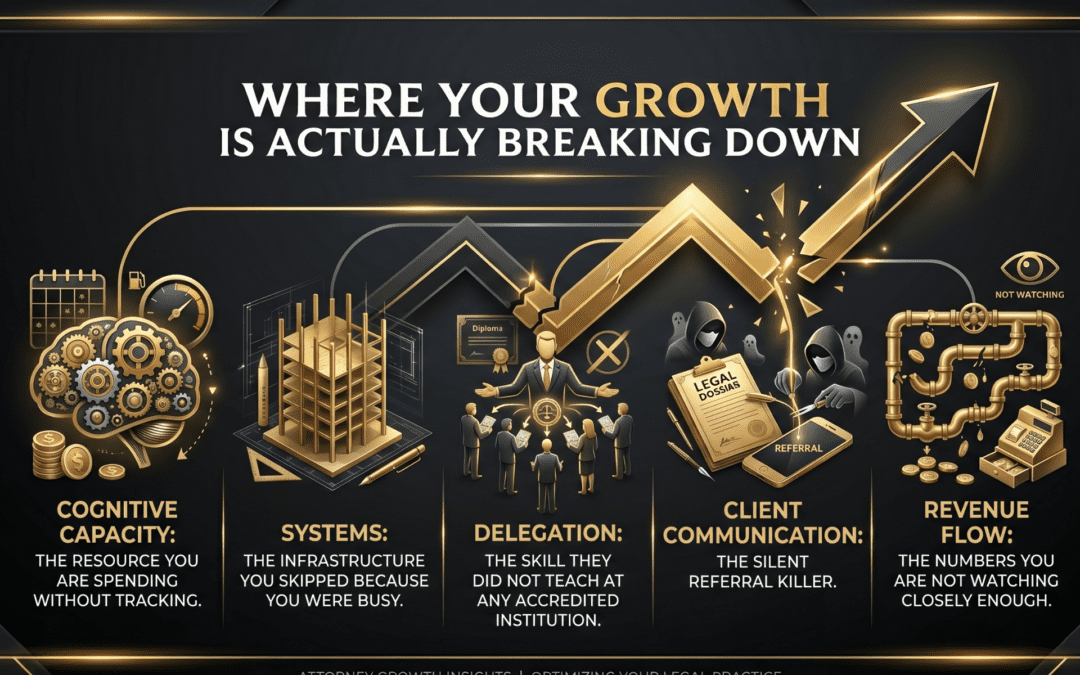
The most important thing any of us can do, in every aspect of our lives, is to seek out our blind spots. Often, we label ourselves: lazy, underperforming, not living to our potential. In reality, you still possess the drive that got you through three years of law school on four hours of sleep and sheer spite. You are missing the mark in specific, diagnosable places that no one has ever handed you a map for. That is what this is. Consider it a map, and consider this your formal invitation to stop guessing.
Most attorneys who feel stuck assume their problem lives somewhere obvious, a thin pipeline, a difficult associate, a quarter that refuses to cooperate. But when you strip away the noise and examine the actual architecture of a high-performing firm, the same five breakdown points appear with the reliability of a difficult opposing counsel. If only they were more interesting or the stuff of bar association keynotes… But they’re not, and they are almost certainly humming along in the background of your practice right now, costing you more than you want to calculate.
- Cognitive Capacity: The Resource You Are Spending Without Tracking
Your brain is your most expensive asset, and you are treating it like a free resource with unlimited storage and no maintenance schedule. Every unfinished task, every client email aging in your inbox, every decision you are holding in your head instead of somewhere with a due date attached, is consuming working memory you need for actual legal thinking. The average attorney carries somewhere between forty and ninety open loops in their head at any given time. That is nothing short of a cognitive traffic jam with no detour signs. If your best thinking is happening in the margins of your worst hours, your firm has a ceiling you built yourself, and you have been bumping your head on it for longer than you realize.
- Systems: The Infrastructure You Skipped Because You Were Busy
You told yourself you would build the systems once things slowed down. Things did not slow down. Ideally, business will never “slow down”. But now you have a practice that depends entirely on your personal memory, your personal follow-through, and your personal ability to hold everything together simultaneously while also being an excellent attorney and a functioning human being. Congratulations, you have built a very expensive, very exhausting job that you cannot leave without everything catching fire. Strong firms run on repeatable processes for intake, client communication, document production, billing, and follow-up. When those processes live inside one person’s skull, every vacation is a liability event, and every new hire is a structured guessing game.
Audit your systems with one question: if you disappeared tomorrow, would anything continue as it should, or would your team spend the week staring at each other in the conference room?
- Delegation: The Skill They Did Not Teach at Any Accredited Institution
Here is something that will sting briefly and then I hope feel enormously freeing: the reason you are not delegating effectively has nothing to do with your team’s competence and everything to do with the fact that you were trained to execute, not to distribute. You were rewarded for doing things yourself, doing them correctly, and doing them faster than everyone around you. That instinct, which served you spectacularly on the way up, is now the thing strangling your capacity at the top.
Effective delegation requires accepting temporary inefficiency in exchange for long-term leverage, and high achievers find that trade about as comfortable as a hostile deposition in August. The firms that scale well have partners who treat delegation as a genuine professional discipline, invest time in expectations and training upfront, and resist the gravitational pull of just handling it themselves. Audit where you are the bottleneck and ask honestly whether that bottleneck is protecting quality or protecting a habit that has outlived its usefulness.
- Client Communication: The Silent Referral Killer
You delivered excellent legal work. The client never referred anyone to you. You are baffled. What else could you have done? My unsexy explanation is that the client felt like a spectator during their own matter, did not fully understand what you were doing or why, and walked away without a story they could hand to someone else. They thought everything worked out fine, but fine does not generate a phone call to a friend. Firms that build communication protocols directly into their practice, proactive updates, plain-language explanations, and touchpoints that make the client feel like a participant rather than a passenger, retain more clients, produce more referrals, and tend to have far fewer of those tense conversations about invoices. Audit every point in your client journey where communication either builds confidence and connection or drains it. If your referrals are low, you have a leak somewhere in that journey.
- Revenue Flow: The Numbers You Are Not Watching Closely Enough
Somewhere between the engagement letter and the collected payment, money is moving in ways you have not fully mapped, and the end of a brutal month is a terrible time to start investigating. Firms with genuine revenue clarity know their realization rate, their collection rate, their average matter value, and their revenue per attorney. More usefully, they know what is affecting those numbers before the quarter ends, and the damage is already deposited into the regret account. If you do not have a clear picture of where revenue is slowing down or leaking out, you are managing by instinct, and although I wish it wasn’t, instinct is a notoriously poor substitute for an actual dashboard.
Trace a dollar from engagement letter to collected payment and note every place it hesitates. That hesitation has a name and a fix, and finding it is worth more than any new client you could sign this month. Close that gap and continue regularly monitoring results.
What the Audit Actually Reveals
When you run yourself through all five of these areas with genuine honesty, what surfaces is not a sweeping verdict on your competence. I know some of my self-reflection and business assessment moments can feel quite exposed. But how can you fix what you do not address? Even when I was uncomfortable watching the ways I stumbled on my path, I knew it was better to stop and fix my ankle or choose a new direction than to keep moving in the same ways, hoping for a different outcome.
What surfaces after your analysis is a practice with real strengths and a handful of specific, fixable structural problems that have been quietly taxing your performance for longer than you have acknowledged. Effort and intention were never the issue. The structure was. Knowing exactly where your firm is breaking down is the first genuinely productive thing you can do for your growth, because you cannot fix what you have not named, and you cannot scale what you have never audited. The five stars are a reckoning, not a rating. And the attorneys who built something real and want it to actually work for them do the reckoning.
Where in your firm are you trusting the system instead of testing it? Your blind spots may surprise you: https://www.lawpreneur.org/mlb-wa8mhjdm